If you’re comparing split system vs multi-split air conditioning, the obvious difference is easy to understand. A single split connects one indoor unit to one outdoor unit, while a multi-split allows several indoor units to share one outdoor unit. What isn’t quite so obvious is which setup will actually work better in your property.
It’s tempting to make the decision purely by counting rooms. One room needs air conditioning? Choose a split. Three rooms? Go multi-split. In reality, that approach can leave you paying for a system that doesn’t quite match how you use your home or workplace.
We think there’s a better way to look at it. You need to consider not only how many rooms require heating and cooling, but when those rooms need it, how much capacity they require at the same time and how practical the installation will be.
In this guide, we’ll explain the differences between the two systems, what they can cost to install and run, and the situations where we’d recommend one over the other.
A single split air conditioning system is the simplest configuration. There’s one indoor unit connected by refrigerant pipework to one outdoor unit.
For example, if you’ve got a south-facing bedroom that becomes uncomfortable every summer but the rest of the house stays relatively manageable, split system air conditioning gives that room its own dedicated heating and cooling system.
Want another bedroom conditioned later? You can install another split, although you’ll then have another outdoor unit to accommodate.
Multi-split air conditioning takes a different approach. Multiple indoor units connect back to one outdoor condenser. Depending on the system, that could mean two bedrooms and a lounge all operating from the same external unit.
Each room can still have room-by-room temperature control. You might set a bedroom to 20°C, leave the home office switched off and run the lounge at 22°C. You’re not forced to condition every connected room whenever the system operates.
There is one important limitation worth understanding. A standard residential multi-split generally can’t heat one room while cooling another at the same time. Different indoor units can have their own temperature settings, but the system as a whole normally needs to be operating in either heating or cooling mode. Buildings that genuinely need simultaneous heating and cooling usually require a more sophisticated system design, such as heat-recovery VRF.
For one room, there’s rarely much debate. A single split air conditioning system will normally have the lower installation cost.
You’re buying fewer components, running less pipework and commissioning a simpler system.
Once several rooms are involved, however, we’d be wary of anyone giving you a universal answer without seeing the property.
Energy Saving Trust currently gives an indicative cost of around £1,900 for an air-to-air heat pump serving one room and around £3,700 for a three-bedroom semi-detached home. Those are broad estimates rather than quotations, but they show why costs can’t simply be calculated by multiplying the price of one indoor unit by the number of rooms.
Multi-split doesn’t automatically mean a cheaper installation
Connecting three indoor units to one outdoor unit sounds simpler than installing three separate systems. Sometimes it is.
Other times, the multi-split requires long refrigerant runs through awkward parts of the property. Pipes may need to travel from upstairs bedrooms, across loft spaces or down external elevations before reaching the shared condenser.
By comparison, three single splits positioned almost directly through an outside wall could involve much shorter pipe runs.
That’s why our air conditioning installation recommendations are based on the actual property rather than a fixed rule about the number of rooms.
Condensate drainage needs thinking about too. Every indoor unit produces water while cooling. Where possible, we’d rather design a route that allows this to drain naturally by gravity. Putting an indoor unit somewhere simply because it looks neat can become less attractive if it then requires a condensate pump that’s harder to access and introduces another component to maintain.
What about running costs?
Neither system wins automatically on energy efficiency.
A modern split air conditioning system can be extremely efficient when it’s conditioning one occupied room. A multi-split can also perform efficiently because inverter technology allows the outdoor compressor to adjust its output as demand changes.
What makes the bigger difference is how you’re using it.
Imagine you’ve installed air conditioning for bedrooms but leave bedroom doors open all evening in the hope of cooling the landing too. The system is now trying to deal with a much larger volume of warm air than it was designed for. Closing the room off and letting the indoor unit condition its intended zone will usually give you much better control.
The same principle applies to thermostat settings. Setting a room to 16°C doesn’t somehow make the air arrive colder twice as quickly. It usually just gives the system a lower target and leaves it working harder for longer.
When comparing models, look beyond the advertised power output. SEER indicates seasonal cooling efficiency, while SCOP describes seasonal heating efficiency. These figures give you a much more useful basis for comparing two air conditioning system types than assuming every multi-split or every single split consumes the same amount of electricity.
Here’s where the split system vs multi-split air conditioning decision becomes more interesting.
Counting rooms alone doesn’t tell us enough. We also want to know whether those rooms are likely to demand full output simultaneously.
Consider two homes that both want multi-room air conditioning across three spaces.
In the first, the home office is occupied from 9am to 5pm. The lounge is used after work, followed by the bedroom overnight. Demand moves around the property throughout the day.
That’s a very natural use case for a multi-split. One outdoor unit can serve all three indoor units, while you’re mainly conditioning the rooms you’re actually occupying.
Now take another property with three bedrooms, all occupied overnight. During a particularly hot evening, every room could be asking for substantial cooling at exactly the same time.
That changes the system design.
A multi-split shares its outdoor capacity
Multiple indoor units don’t each have an unlimited supply of cooling capacity. They’re connected to a shared outdoor unit with a finite output.
That doesn’t mean you’ll notice a drop in performance every time two rooms are switched on. Correctly designed systems are built to handle multiple zones.
What we need to avoid is sizing a system around the assumption that only one room will ever require significant output when, in reality, the whole family turns the air conditioning on at bedtime.
Room size isn’t enough to determine that capacity either. A modest loft bedroom with roof windows and afternoon sun can have a far higher cooling load than a larger shaded room downstairs.
Glazing, insulation, ceiling height, orientation and heat-producing equipment all influence the result. A home office containing two monitors and a powerful computer, for example, can behave quite differently from a bedroom of exactly the same floor area.
This is why proper system design beats choosing equipment purely from an online room-size calculator.
If you’re conditioning one problem room, we’d usually start with a single split.
Air conditioning for bedrooms is a good example. Perhaps one upstairs bedroom faces west and becomes uncomfortable late in the day, while the other rooms remain fine. There’s little reason to create an elaborate multi-split system if there’s only one genuine problem to solve.
Single splits also offer an advantage if you want to build your system gradually.
You could install wall-mounted air conditioning in the home office now and decide a year later whether the bedroom needs its own unit. The second installation doesn’t depend on whether the first outdoor condenser has spare connections or sufficient capacity.
There’s another consideration that’s easy to overlook: resilience.
With several completely independent split systems, a fault affecting one outdoor unit usually affects only its connected indoor unit. Put four rooms on one multi-split condenser and that outdoor unit becomes a shared point of failure. If it develops a problem, several rooms can potentially lose heating and cooling until it’s repaired.
For most homes, that won’t outweigh the aesthetic advantage of having one outdoor unit. In a commercial air conditioning system serving rooms where temperature control is operationally important, however, redundancy can deserve more attention.
When Does Multi-Split Air Conditioning Make More Sense?
Multi-split becomes particularly attractive when several rooms genuinely require conditioning and you don’t want multiple condensers around the outside of the property.
A typical example might be two bedrooms and a home office. You retain independent control of each indoor unit but have a much cleaner external installation.
This can be especially valuable where wall or garden space is limited. Four separate split systems could mean finding appropriate positions for four outdoor condensers, while multi-split air conditioning may reduce that to one.
Appearance can be a legitimate consideration too. There’s nothing wrong with making installation decisions partly around how the finished property will look. We just wouldn’t let aesthetics override basic engineering. An outdoor condenser still needs adequate airflow and service access, while pipe routes need to remain practical.
Noise deserves similar consideration. Outdoor units have become much quieter, but positioning one immediately beneath a bedroom window simply because it’s the shortest pipe route may not be the best long-term decision. We look at where the equipment sits in relation to your rooms and neighbouring properties before settling on the final location.
Which option is best at a glance?
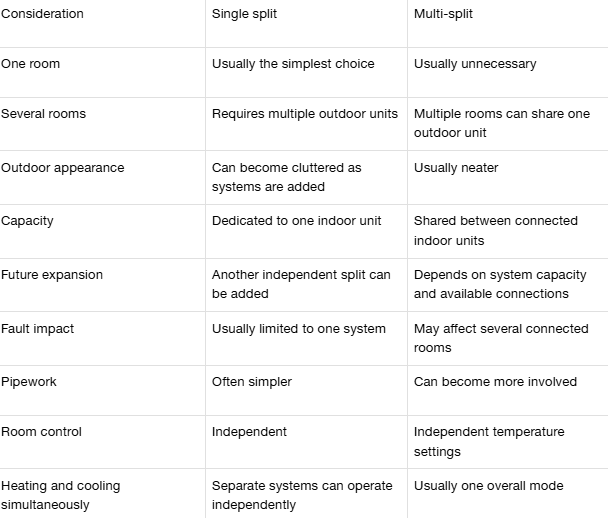
Before deciding on the best air conditioning system for home use, we’d narrow the choice down with three practical questions.
Which rooms actually need air conditioning?
There’s a difference between having five bedrooms and needing air conditioning in five bedrooms. A cool north-facing spare room that’s occupied three weekends a year may not justify its own indoor unit.
When are those rooms occupied?
A lounge used in the evening and bedrooms used overnight produce a different demand pattern from four bedrooms all occupied at the same time.
This is one of the most useful pieces of information you can give professional air conditioning installers during a survey. Tell us how you actually live in the property, rather than simply pointing at the rooms.
Where can the equipment realistically go?
Indoor unit positioning affects airflow and comfort. For a bedroom, we wouldn’t generally want cold air firing directly across the bed. In a home office, directing it straight towards someone’s desk can become irritating surprisingly quickly.
Then there’s the outdoor unit, refrigerant pipework, electrics and condensate drainage to accommodate. Sometimes those practical details make the decision between single and multi-split for you.
Any installation involving regulated F-gases also needs the appropriate competence. Current GOV.UK guidance states that people working on stationary air conditioning and heat pump systems containing F-gas require the relevant qualifications for activities including installation, servicing, maintenance and leak checking. Companies carrying out relevant work on other people’s equipment also need the appropriate certification.
It’s one reason we’d recommend making installation quality part of your purchasing decision rather than focusing only on the model printed on the quotation.
There isn’t a universal winner in the split system vs multi-split air conditioning comparison.
For a single bedroom, office or troublesome loft conversion, a dedicated split system is normally the cleanest and most cost-effective answer. It gives the room its own capacity without making the installation more complicated than necessary.
When you’re conditioning several rooms and want to minimise the number of outdoor units, a multi-split can be an excellent solution. You get zoning and room-by-room temperature control while keeping the exterior of the property much tidier.
The point we’d focus on isn’t simply how many rooms you’ve got. It’s when those rooms need heating or cooling at the same time.
Two apparently identical three-bedroom homes can require very different systems once we account for solar gain, occupancy, insulation and the way each household uses its rooms.
If you’re weighing up a split air conditioning system against multi-split air conditioning, the most useful next step is a proper survey. We can assess the rooms, work out the likely heating and cooling loads, plan sensible indoor and outdoor unit positions and recommend a system that fits the property rather than forcing the property to fit the system.
Get in touch with our team to discuss your air conditioning installation, or arrange a survey and we’ll help you work out which setup offers the best balance of comfort, efficiency and long-term value.