If you’re budgeting for a commercial building, a useful starting point is around £70 to £120 per unit for a routine one-off service. That’s a broad UK benchmark rather than a commercial quotation. Checkatrade’s 2026 air con servicing cost guide puts home and office servicing within this range, while also noting that difficult access and additional repairs can increase the final bill.
In practice, the commercial air conditioning maintenance cost depends on much more than how many units you can see on the wall or ceiling. We need to know what equipment is installed and how it’s configured. We also need to understand how easily our engineers can reach it. Once we’ve established that, we can look at how frequently the system should be maintained and what condition it’s currently in.
For a facilities manager, this is a better way to budget than multiplying a generic service rate by the number of indoor units.
The Number of Indoor and Outdoor Units
The starting point is the asset list.
“Ten air conditioning units” could mean ten independent split systems. It could instead mean several indoor units connected to fewer outdoor units through a multi-split or VRF system. Those arrangements don’t necessarily require the same amount of labour.
We need enough time to properly inspect and service the equipment rather than simply clean the visible filters. Our own air conditioning maintenance service includes checks to indoor components and drainage alongside inspection of outdoor equipment, pipework and system operation.
A good example of why asset information is important is our Grappenhall Care Home project. The installation included 14 split air conditioning systems plus a central controller. If a future maintenance quotation simply described the site as having “14 units”, it wouldn’t give the facilities team much information about exactly what was being maintained.
When we calculate commercial air conditioning maintenance cost, we’d rather work from a proper equipment schedule than a rough unit count.
The Type and Condition of the System
System type affects the work involved.
A straightforward split system can generally be serviced more quickly than a large VRF installation where several indoor units are connected into the same refrigerant system. With VRF equipment, fault history and central controls may also need closer attention during a visit.
Condition is equally important. On a regularly maintained system, we’re usually dealing with predictable servicing tasks. If equipment hasn’t been properly looked after for several years, the first maintenance visit can expose work that isn’t routine servicing.
Blocked drainage is one example. We can also find damaged pipe insulation or faults already stored within the controls. Heavily contaminated coils may need more attention than a normal maintenance clean.
Our approach is to separate those findings from planned maintenance rather than quietly treating every issue as part of the service. This lets the person responsible for the building see which costs relate to normal maintenance and which are remedial repairs.
Access Can Change the Labour Cost
Two sites with identical air conditioning equipment can have completely different servicing costs because of where the equipment has been installed.
A wall-mounted split system with an outdoor unit at ground level is relatively straightforward to reach. Put the outdoor unit on a restricted roof or the indoor equipment above a high ceiling, and the job changes.
You may need:
- specialist access equipment
- roof permits or escorts
- additional engineers for safe access
- parking or loading arrangements
- early morning, evening or weekend attendance
Checkatrade specifically lists access equipment, parking and travel among the additional costs that can affect an air conditioning service.
We’ve seen the effect of working restrictions on real commercial projects. During our St James replacement project in Manchester, the building remained a live office. Internal work had to be scheduled over a weekend so the system was ready before staff returned on Monday, while part of the roof required additional harness training.
A maintenance visit can face similar restrictions. If servicing can only happen outside trading hours, that needs to be established when the contract is priced rather than discovered after the first engineer arrives.
How Often Does the Equipment Need Servicing?
Service frequency has an obvious effect on annual cost. Two scheduled visits will cost more than one, but simply choosing the cheapest frequency isn’t always sensible.
We look at how the equipment is being used.
An office system that operates during normal weekday hours has a different duty cycle from cooling serving a server room. Equipment in environments where filters become contaminated quickly may also need closer attention.
Filter condition shouldn’t be dismissed as basic housekeeping. Daikin explains that clogged air conditioning filters reduce airflow and heat exchange, affecting capacity and system efficiency.
The right service frequency should be based on how the equipment actually operates, rather than automatically assuming every commercial building needs exactly the same maintenance schedule.
Site Size and Multiple Locations
For businesses with multiple premises, we’d also want to understand whether maintenance is being managed as individual sites or as one estate.
There can be efficiencies in planning several locations under the same service agreement, particularly when there’s a consistent asset register and reporting format. However, each building still needs its own assessment because access and equipment condition may vary considerably.
If you’re responsible for a property portfolio, ask for pricing to be broken down by site. It makes budgeting easier and lets you identify locations where older equipment or awkward access is pushing the maintenance spend up.
A one-off service can work well for a small installation or when you’ve inherited a building and want to establish the condition of the equipment first.
You pay for the visit and receive the findings. Any repairs identified afterwards are normally dealt with separately.
A planned maintenance agreement makes more sense where air conditioning is important to the operation of the building. Scheduled visits create a maintenance history and make annual spending more predictable. They also provide regular opportunities to identify developing problems before they result in an urgent breakdown.
When comparing the commercial air conditioning servicing cost between providers, don’t compare the headline annual figures alone. Check the scope.
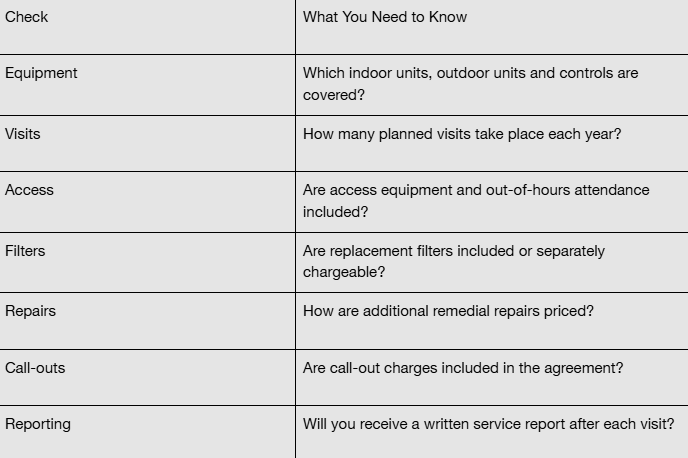
At Houlkair, our planned air conditioning maintenance includes routine servicing and filter attention, along with performance checks and early fault detection. Following the visit, we explain any issues found so you know what requires attention and why.
That level of detail is important when comparing an AC maintenance contract cost. A cheaper contract isn’t cheaper if several services you assumed were covered are actually chargeable extras.
This is an area we’d recommend checking carefully because regular maintenance doesn’t automatically cover every compliance requirement associated with commercial air conditioning.
For equipment containing F-gases, the required leak-check frequency depends on the amount of refrigerant expressed as CO2 equivalent and its global warming potential. CurrentGOV.UK guidance on F-gas leak checks states that equipment containing between 5 and less than 50 tonnes CO2 equivalent generally requires leak checks at least every 12 months. Higher quantities can require more frequent checks.
There’s a separate requirement for air conditioning energy inspections in England and Wales. Systems with an effective rated output of more than 12kW must be inspected by an accredited energy assessor at intervals of no more than five years. Importantly, several smaller units controlled by the same person can collectively fall within this requirement. GOV.UK’s guidance on air conditioning inspections
This inspection is separate from routine servicing.
When comparing a commercial air conditioning service price, ask what compliance work is included in the maintenance contract and what will be invoiced separately. It prevents an apparent saving at quotation stage becoming an unexpected cost later.
The annual maintenance figure only tells you how much you’re spending on planned attendance. It doesn’t show the financial risk associated with the equipment failing.
The consequences vary enormously by building.
Poor cooling in an unused meeting room may be inconvenient. Losing cooling to a heavily occupied area during hot weather can cause far more disruption. Critical cooling supporting IT equipment presents another level of risk again.
Energy performance should also be considered.
Government guidance specifically highlights blocked filters and heat exchangers when assessing air conditioning efficiency. Restricted airflow can increase the resistance the system has to work against or cause equipment to underperform.
Daikin also reports that its automatic filter-cleaning technology can produce running-cost savings of up to 20% compared with manual filter cleaning on compatible equipment. That doesn’t mean servicing every air conditioner will reduce its energy bill by 20%, but it demonstrates how much filter condition can affect some commercial systems.
There’s an even wider lesson around operating controls. A 2026 UK government consultation on air conditioning inspections reported feedback suggesting that implementing a full package of inspection recommendations could typically produce 30% to 40% energy savings. Lower-cost changes, including correcting system schedules, were reported as potentially achieving 10% to 20%.
Those aren’t maintenance savings and shouldn’t be presented as such. They do show why facilities managers should look beyond the maintenance invoice and consider how efficiently the system is actually operating.
One of the easiest ways to underestimate a maintenance budget is to take a price per unit and multiply it by the number of indoor units.
Imagine two offices with eight indoor units.
The first has accessible wall-mounted split systems and outdoor equipment at ground level.
At the second building, several indoor units are ceiling cassettes. Its condensers are on a restricted roof and servicing is only permitted before employees arrive.
The asset count looks similar. The amount of engineer time required doesn’t.
We’d always want to understand those practical details before agreeing a maintenance contract. It’s also why a facilities manager should be cautious of a quotation produced without anyone asking about access requirements or the existing system.
If the contractor has priced for straightforward access but discovers that a roof permit and specialist equipment are required on the first visit, the original figure stops being particularly useful.
Rather than treating the annual maintenance contract as the entire budget, I’d separate planned expenditure from potential reactive costs.
Your budget may need to account for:
- planned maintenance visits
- replacement filters or consumables not included in the contract
- access and out-of-hours costs
- remedial repairs on ageing equipment
- reactive call-out charges
- statutory inspections outside the maintenance agreement
For a small office installation, the £70 to £120 per-unit market benchmark can give you a basic sense-check. Once you’re dealing with multi-split systems, VRF systems or larger estates, an asset-based quotation becomes much more useful.
The most accurate commercial air conditioning maintenance cost comes from understanding what equipment is installed and what condition it’s in. We then need to know what’s involved in accessing and maintaining it properly.
That gives you a realistic maintenance budget rather than a headline service price that changes as soon as the engineer arrives.
If you’re responsible for commercial air conditioning in Manchester or elsewhere across the North West, we can assess your equipment and recommend a maintenance plan based on the actual site.
We’ll make the scope clear from the start and explain what’s included. If we identify existing problems or additional repair work, we’ll flag those separately so you can make an informed decision without unexpected costs.