For most commercial air conditioning systems, we’d recommend professional servicing at least once a year. If the system provides both heating and cooling throughout the year, two visits annually will usually be a more sensible starting point. Systems operating for long hours, working in dirty environments or protecting temperature-sensitive areas may need attention every three months.
There isn’t one service interval that works for every commercial building. The right schedule depends on how heavily the equipment is used, the environment it operates in and what engineers are finding during previous maintenance visits. A fixed annual date might be enough for one system, while another needs much closer attention to prevent performance problems or unexpected faults.
As a practical starting point, we’d look at the building and system roughly like this:
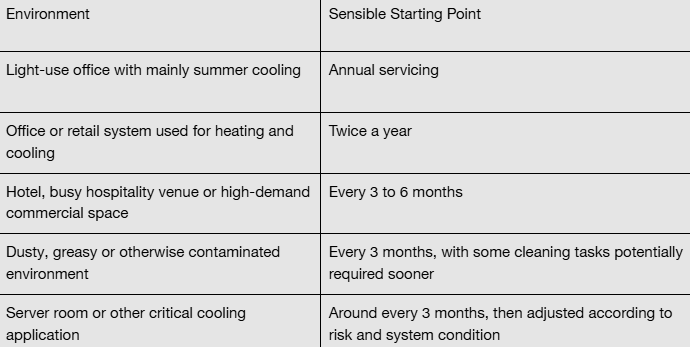
These aren’t universal legal service intervals. They’re a starting point for planned maintenance.
One manufacturer’s instructions show just how much operating hours can change the requirement. Toshiba’s light-commercial installation guidance states that where an indoor unit operates for around eight hours per day, the indoor and outdoor units should generally be cleaned at least once every three months. It warns that poor cleaning can contribute to reduced performance, icing and water leakage.
It’s tempting to say that an office needs servicing twice a year while a restaurant needs servicing quarterly, but we’d want to know how the systems are being operated first.
An office cassette running from 8am until 6pm, five days a week, experiences a very different duty from another system used for occasional meeting-room cooling. Likewise, air conditioning in a hotel reception could operate almost continuously even though other systems in the same building only run when individual rooms are occupied.
When we’re looking at commercial AC service intervals, we’d check the actual operating pattern rather than relying on the label attached to the building.
Controls can also tell part of the story. Modern systems may provide fault histories and operating data that help us see whether equipment is working harder than expected. Carrier and Toshiba’s maintenance guidance specifically includes checking control settings, fault-code history, sensor information and system performance during maintenance.
Dust, grease and airborne debris can make an otherwise reasonable six-month maintenance schedule too long.
A unit serving a clean meeting room shouldn’t accumulate contamination at the same rate as one close to a commercial kitchen. Outdoor equipment near busy roads or exposed rooftop positions can also collect debris that restricts airflow.
We see this reflected in Houlkair’s own air conditioning maintenance guidance. Our service checks include filters, indoor coils and condensate drainage, alongside the condenser and outdoor airflow. We also point out that external units around Manchester can collect contamination from traffic and weather.
There’s a useful real-world example from a commercial HVAC discussion online. A maintenance worker at a fast-food operation described filters on rooftop units above the kitchen becoming coated with grease every month. That doesn’t mean every restaurant requires monthly professional servicing. It does show why copying an office air conditioning maintenance frequency into a greasy hospitality environment can leave filters dirty long before the next scheduled visit.
The service visit and the filter inspection interval don’t have to be the same.
Filters are a good example. Depending on the system, staff may be able to carry out simple visual checks between professional services. If filters are visibly loading up well before the engineer returns, that’s useful evidence that part of the maintenance schedule needs changing.
Restricted airflow makes the system work harder. The US Environmental Protection Agency’s ENERGY STAR HVAC maintenance guidance notes that dirty coils reduce cooling performance and increase running time, while airflow problems can reduce system efficiency by up to 15%.
We’d rather shorten a filter inspection or cleaning interval than repeatedly arrive at a six-month service and find the system has spent several months struggling for airflow.
This is where we think commercial maintenance schedules can be much better.
Don’t decide the commercial AC servicing frequency once and leave it unchanged for the next five years. Use the first few maintenance visits to find out what your building actually needs.
At each service, we’d want useful information recorded, including:
- the condition of filters and heat exchangers;
- whether condensate trays and drains were beginning to block;
- recent controller fault codes;
- temperature and performance readings;
- visible deterioration or electrical issues;
- previous refrigerant leaks or repairs;
- anything restricting access to the equipment.
If a system serviced every six months is repeatedly clean and operating correctly, its existing schedule may be appropriate. If filters are heavily contaminated after three months or condensate drains are repeatedly close to blocking, we’d review that interval rather than accepting the same problem at every service.
This approach lines up with SFG20’s industry maintenance framework. It allows maintenance frequencies to be adjusted where justified by the asset, its operating environment and risk profile, with the reasoning behind changes recorded.
For a facilities manager, that’s a much stronger maintenance strategy than simply saying, “We’ve always serviced it every six months.”
Maintenance frequency isn’t much use if the engineer can’t properly access the equipment when the visit takes place.
Ceiling cassettes may sit above desks or fixed furniture. Outdoor units can be installed on roofs where controlled access is needed. Plant rooms may be restricted during normal working hours. In hospitality or retail environments, engineers might need to work around customers and trading periods.
We’ve encountered exactly this kind of operational constraint on commercial projects. During our St James project in central Manchester, the building remained a live office, so internal work had to be completed over a weekend before staff returned on Monday. That project involved replacement rather than routine servicing, but the planning principle is the same: access and operating hours need to be considered before the engineer arrives.
For planned maintenance, arranging suitable access in advance means the engineer can inspect what actually needs inspecting rather than losing part of the visit waiting for rooms, ceiling voids or rooftop areas to become available.
This distinction is important.
Your planned maintenance schedule and your legal F-Gas leak-check frequency aren’t necessarily the same thing.
According to current GOV.UK F-Gas guidance, stationary air-conditioning equipment containing applicable quantities of fluorinated refrigerant can require leak checks at intervals determined by the system’s CO2-equivalent refrigerant charge.
For relevant systems, the maximum interval can be:
- every 12 months from 5 to under 50 tonnes CO2 equivalent;
- every 6 months from 50 to under 500 tonnes CO2 equivalent;
- every 3 months at 500 tonnes CO2 equivalent or above, subject to the specific rules covering leak-detection systems.
The government also requires certain F-Gas records to be kept for five years.
An engineer should establish what refrigerant the equipment contains and its charge rather than assuming that an annual service automatically satisfies the site’s F-Gas obligations.
There’s another requirement facilities managers sometimes mix up with routine servicing.
In England and Wales, GOV.UK guidance on air-conditioning inspections requires systems with an effective rated output of more than 12kW to receive an energy-efficiency inspection at intervals of no more than five years. Importantly, several smaller units can fall within the requirement when they’re treated as one system under common control and their combined output exceeds 12kW.
That five-year inspection doesn’t replace preventative maintenance. Government guidance specifically notes that maintenance and cleaning need to take place more frequently than the statutory energy-efficiency assessment.
What Are the Signs You Should Service the System Earlier?
You don’t need to wait for the next planned visit if the system’s behaviour changes.
We’d arrange an earlier inspection if you notice reduced airflow, repeated fault codes or a noticeable fall in heating or cooling performance. Water appearing around an indoor unit also needs investigating rather than being left until the next service.
Unusual noise is another useful warning sign. Daikin notes that increased noise can be associated with clogged filters, while persistent or abnormal sounds can indicate a mechanical problem requiring professional attention.
A recurring fault is particularly important. Resetting a controller every few days might get the system running again temporarily, but it doesn’t explain why the fault keeps returning. The fault history should form part of the diagnosis.
For most businesses, we’d use annual servicing as the minimum starting point and move to twice-yearly servicing where systems provide year-round heating and cooling. Long operating hours, dirty environments or critical cooling can justify three-monthly maintenance or additional checks between full services.
More importantly, how often commercial air conditioning should be serviced shouldn’t be decided from the calendar alone.
Look at operating hours. Check what condition the filters and coils are in when the engineer arrives. Review fault history and condensate problems. Consider refrigerant compliance separately. Then adjust the planned maintenance frequency using what the equipment is actually telling you.
That’s how we’d build a maintenance schedule at Houlkair. The aim isn’t to service equipment as often as possible. It’s to service it often enough that developing problems can be found before they start affecting the building, while avoiding unnecessary visits where the system’s condition doesn’t justify them.