If you are trying to work out how to ventilate a room without windows, you are probably dealing with a space that feels stale, damp, stuffy or uncomfortable. It might be an internal bathroom, a utility room, a small office, a basement, a storage cupboard or even a bedroom that never seems to feel fresh, no matter how often you leave the door open.
The problem is simple: a room without windows has no natural route for stale air to escape or fresh air to enter. That means odours, moisture, heat and indoor pollutants can build up quickly.
This is where many people get caught out. They put a fan in the corner, buy an air freshener, run a dehumidifier or leave the door open for a while, but the room still feels stale again later. The reason is that air movement is not the same as ventilation. Moving trapped air around can make a room feel better temporarily, but it does not solve the cause.
Poor ventilation can lead to musty smells, condensation, mould growth and a less comfortable indoor environment. In rooms used for working, sleeping, washing or drying clothes, the issue can become more noticeable because moisture and carbon dioxide can build up faster.
In this guide, we will explain how to improve ventilation in a room without windows, what actually works, where quick fixes fall short, and when a proper ventilation system is the better long-term option.
A windowless room does not ventilate itself. Without a direct opening to outside air, the room depends on doors, vents, grilles, fans or mechanical systems to move stale air out and bring replacement air in.
That distinction matters. A fan may create a breeze, but if the air has nowhere to go, it is mostly circulating the same stale air. Proper ventilation needs a route.
The main problems in a room without windows are usually:
- Stale air and odours: smells from people, toilets, laundry, cleaning products or stored items can linger.
- Excess moisture: showers, drying clothes, mopping floors and even breathing add water vapour to the air.
- Condensation: humid air settles on cooler surfaces such as mirrors, tiles, walls and ceilings.
- Mould growth: damp surfaces create the right conditions for mould growth, especially in bathrooms, cupboards, basements and utility rooms.
- Poor comfort: the room can feel warm, heavy or stuffy soon after the door is closed.
- Indoor pollutants: dust, VOCs from paints or furniture, and other airborne particles can hang around for longer.
A useful question to ask is: where is the stale air going?
If there is no clear answer, the room probably does not have proper ventilation. It may have air movement, but not reliable air exchange.
For example, a fan blowing across a closed internal bathroom will move humid air around the room. A fan helping push air towards an open doorway, while an extractor fan removes air elsewhere, is much more useful.
This is the practical detail many people miss. You are not just trying to make air move. You are trying to create a path.
There is no single fix that works for every space. The best solution depends on how the room is used, how often people occupy it, how much moisture it produces and whether air can be ducted outside.
1. Install an Extractor Fan for Moisture and Odours
An extractor fan is usually one of the most effective options for a windowless room that creates moisture or smells.
It is especially useful for:
- Bathrooms
- WCs
- Utility rooms
- Laundry rooms
- Internal en-suites
- Small treatment rooms or workspaces
An extractor fan works by pulling stale or humid air out of the room and discharging it outside. That final part is important. The air should not be vented into a loft, ceiling void, cupboard or another internal space, because that only moves the damp air somewhere else.
In a bathroom without windows, for example, a properly ducted extractor fan can remove steam after showers and reduce condensation on mirrors, tiles and ceilings. A fan with a timer or humidity sensor is often better than a basic switch-operated model because it continues running after the room has been used.
UK ventilation guidance gives a useful indication of why moisture-heavy rooms need proper extraction. Approved Document F lists minimum intermittent extract rates of 15 litres per second for bathrooms, 30 litres per second for utility rooms and 6 litres per second for sanitary accommodation such as WCs. You do not need to remember the numbers, but they show the principle clearly: a small, weak fan is unlikely to perform well in a damp internal room.
Practical tip: if your extractor fan is noisy but the room still feels damp, it may be underpowered, blocked, poorly ducted or starved of replacement air.
2. Add a Vent, Grille or Door Gap for Replacement Air
Extractor fans need make-up air. If a room is too sealed, the fan struggles to pull air through properly.
This is one of the most overlooked parts of ventilation for room without windows. People focus on the fan, but forget the air inlet. Without replacement air, extraction becomes weaker and noisier.
You can improve airflow through:
- A door undercut
- A transfer grille
- A passive wall vent
- A louvred door
- A high-and-low vent arrangement
- A ducted air supply or extract system
These features do not always ventilate a room by themselves, but they allow air to move from an adjacent hallway, landing or room into the windowless space.
For example, a small storage cupboard that smells musty may only need a louvred door or passive vent to stop air sitting still. A utility room with wet laundry, on the other hand, will usually need stronger extraction because moisture is being added regularly.
A simple way to think about it is this: air cannot leave efficiently unless other air can replace it.
Practical tip: hold a tissue near the bottom of the door while the extractor fan is running. If there is no movement at all, the room may not be getting enough replacement air.
3. Use a Fan Strategically
A fan is not a ventilation system, but it can still help when used properly.
The mistake is placing a fan in the middle of a closed room and expecting it to freshen the space. It may make the room feel cooler for a while, but it is still moving the same air around.
A better approach is to use the fan to push stale air towards an exit point, such as:
- An open door
- A hallway with better airflow
- A nearby extractor fan
- A room with an open window
- A passive vent or grille
For example, in a windowless home office, place the fan near the back of the room and angle it towards the open door. If a window is open elsewhere in the property, or a kitchen or bathroom extractor is running, the fan can help move stale air out of the office and into a space where it can be removed.
Small details can make a real difference. Avoid blocking vents with furniture. Leave internal doors open after using a stuffy room. Move storage boxes away from external walls. Damp, still corners often appear where air cannot circulate properly.
Practical tip: if one corner of the room smells musty, do not just spray air freshener. Move furniture away from the wall and check whether air can pass behind it.
4. Use a Dehumidifier for Damp, Not Fresh Air
A dehumidifier can be very useful in a room that feels damp. It removes moisture from the air, which can help reduce condensation and make the space feel more comfortable.
It is especially useful for:
- Mild condensation
- Damp storage rooms
- Laundry areas
- Cold internal rooms
- Spaces where clothes are dried indoors
However, a dehumidifier does not bring in fresh air. It does not remove carbon dioxide from a room used for working or sleeping. It does not extract odours outside. It also does not deal with stale air in the same way as proper ventilation.
For example, if an internal bathroom smells damp after every shower, a dehumidifier may reduce moisture, but it will not remove steam and odours as effectively as a ducted extractor fan.
That does not mean dehumidifiers are a waste of money. They can be excellent for moisture control. The problem comes when they are treated as a complete answer to a ventilation issue.
Practical tip: place the dehumidifier where air can move freely around it. If it is squeezed behind furniture or hidden in a corner, it will not work as well.
5. Consider Mechanical Ventilation or Fresh-Air Air Conditioning
If the room is used regularly, keeps smelling stale or has recurring condensation, quick fixes may not be enough. This is when a proper mechanical solution becomes worth considering.
A ventilation system can create a controlled route for stale air to leave and replacement air to enter. Depending on the property, this could include:
- A ducted extractor fan
- Continuous mechanical extract ventilation
- Positive input ventilation
- A fresh-air supply system
- Air conditioning designed alongside ventilation
The air conditioning point needs some nuance. Standard air conditioning usually cools or heats recirculated indoor air. It can make a room feel more comfortable, but it does not always provide fresh air unless the system is designed to do so.
That said, air conditioning can still play an important role. In home offices, bedrooms, treatment rooms, server rooms, commercial spaces and converted internal rooms, a properly specified air conditioning and ventilation setup can improve comfort, airflow and temperature control far more effectively than portable fans or temporary fixes.
A useful way to look at it is this: cooling improves comfort, but ventilation improves how the room functions. In many windowless rooms, the best result comes from considering both together.
When people ask how to get fresh air in a room without windows, they are usually looking for one product that solves the issue. Sometimes a single extractor fan is enough. More often, the answer is an airflow route.
Fresh air can enter a windowless room through:
- An open door
- A gap beneath the door
- A transfer grille
- A passive vent
- A ducted supply system
- A whole-home ventilation system
- A fresh-air system designed with heating or cooling
The important part is that the air has to come from somewhere with better air quality. Borrowing stale air from a poorly ventilated hallway will not solve much.
For example, if a windowless office opens onto a landing, and the landing has no fresh air either, the office may still feel stuffy. Opening a window elsewhere in the property while using a fan or extractor can help create a stronger flow path.
This is why the best ventilation fixes often look beyond the room itself. You may need to improve the wider airflow route, not just add a device inside the problem room.
Different rooms need different solutions. A small cupboard does not need the same setup as a bathroom, bedroom or workspace.
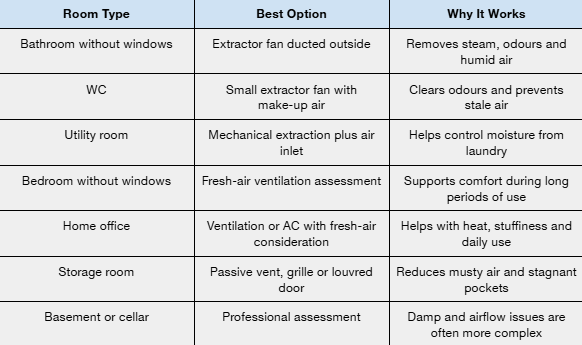
This is why improving ventilation in a room without windows is not always answered by a single product.
A bathroom usually needs extraction. A bedroom needs reliable fresh air. A storage room may only need gentle airflow. A commercial room may need a more robust ventilation system that supports daily use, comfort and long-term reliability.
Some products help, but they are often misunderstood.
- A fan alone: improves air movement, but does not bring in fresh air unless stale air has somewhere to go.
- An air purifier: can filter dust, pollen and some particles, but it does not remove moisture or replace air.
- A dehumidifier: reduces humidity, but does not remove carbon dioxide, odours or stale air.
- Air freshener: masks smells, but does not fix the cause.
- Standard air conditioning: usually controls temperature, but may not provide fresh air unless specified as part of a ventilation approach.
- Leaving the door open: helps a little, but is unreliable for bathrooms, utility rooms or rooms used for long periods.
This does not mean these options are pointless. A fan, purifier or dehumidifier can be useful. The issue is expecting them to do a job they were not designed to do.
For example, an air purifier may make a windowless office feel cleaner, especially if dust is a problem. But if the room still feels stuffy after an hour with the door closed, the issue is likely air exchange, not filtration.
You should consider a proper ventilation solution if:
- The room smells musty even after cleaning
- Condensation keeps coming back
- Mould appears on walls, ceilings, furniture or stored items
- The room feels stuffy soon after the door is closed
- The space is used for sleeping, working or long periods of occupation
- There is a shower, toilet, washing machine or dryer in the room
- The existing extractor fan is noisy, weak or ineffective
- You want cooling as well as better airflow
A professional can assess the room size, ducting options, moisture level, airflow path and how the space is used. They can also check whether an existing fan is blocked, underpowered or venting incorrectly.
In many cases, the best solution is not the most complicated one. It may be a better extractor fan, a new duct route, an air inlet, or an air conditioning system designed with ventilation in mind. The value comes from matching the system to the room rather than guessing.
Understanding how to ventilate a room without windows comes down to one simple principle: stale air needs a way out, and fresh air needs a way in.
Fans, dehumidifiers and air purifiers can all help, but they have limits. A fan moves air. A dehumidifier removes moisture. An air purifier filters particles. None of them automatically create proper ventilation unless there is an airflow route.
For small, lightly used rooms, a vent, grille, door gap or better fan placement may be enough. For bathrooms, utility rooms, bedrooms, offices and commercial spaces, a proper ventilation system is often the better long-term answer.
If a room without windows feels stale, damp or uncomfortable no matter what you try, it is worth having it assessed properly. The right solution should not just make the room feel better for a few minutes. It should help it stay fresher, healthier and more comfortable every day.